Winter 2026 Edition
Chan Dharma Community

Several years ago I decided I wanted to buy a small figure of the Buddha and set up a little altar to help me focus my meditation practice in a particular place in my home. I did a lot of online shopping, looking first at what appealed to me artistically. That’s when I started taking more serious notice of the fact that different statues show the Buddha in different ways. As I looked into this more deeply, I learned that this is not solely an artistic choice. How the Buddha is portrayed has both an external form and an internal meaning.
There are many ways of describing and understanding these outward forms. I’ve based the information here on the book Buddhist Rituals & Observances, by Ajahn Sucitto and Ajahn Candasiri (2001, Amaravati Publications). They begin by explaining, “Buddha-images come in a range of postures—standing, sitting, walking and reclining. Each image suggests a different way of reviewing Awakening. Those standing suggest a balanced authority; the sitting posture suggests an upright composure; the walking, a sense of fluid engagement; and the reclining, a sense of accomplishment.”
I learned that the positions of the Buddha’s hands, called mudras, also convey specific meanings. I’ll describe some of the most common ones here, along with observations from members of our sangha about what resonates for them about each mudra. I’ll start with the mudra I chose for my own Buddha statue.
—Beth Adelman
Bhumisparsha (Earth-Touching) Mudra
In this mudra, the Buddha’s right hand reaches down to touch the ground by his right knee. It symbolizes the moment of his awakening. There’s a story that when the Buddha sat under the bodhi tree nearing his enlightenment, he was tempted by Mara, who you could think of as a demon or as the personification of delusion. In Mara’s final temptation, he suggested that Buddha was not worthy of being enlightened, and even if he was, he could never teach it to others. “Who will witness your enlightenment?” Mara roared. Buddha reached down and touched the Earth, making it his witness in his moment of awakening.
Self-doubt is one of my demons as well. Mara also sometimes whispers in my ear that enlightenment is out of reach for me, and I am inspired by the Buddha’s ability to put aside the delusion of self-doubt. I also believe that understanding my connection to the Earth is symbolic of how I understand interdependence and causes and conditions. When I separate myself from the world—me, myself—I am under the delusion that I am a separate self. When I better understand my connection with the world (when I touch the Earth, as Buddha did), I can put aside that delusion and begin to understand emptiness.
—Beth
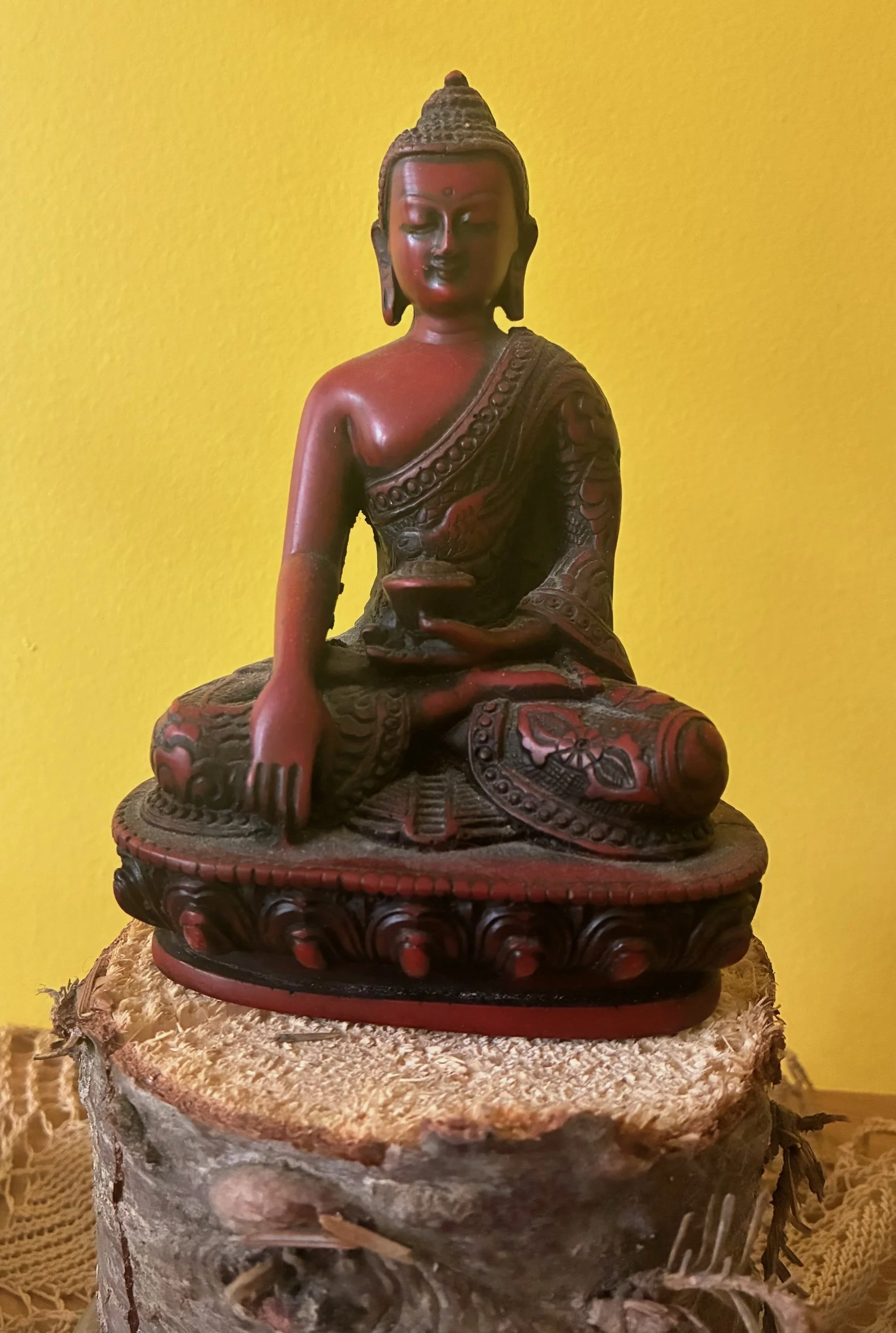
Photo by Beth
Dharmachakra (Turning the Wheel of Dharma) Mudra
In this mudra, the right hand is held higher than the left and the curled forefinger of each hand touches the thumb to form a circle. The other fingers radiate out like the spokes of a wheel. This mudra is associated with the Buddha’s teachings of the Four Noble Truths and the Noble Eightfold Path—his first sermon, where he figuratively set the Dharma wheel in motion. This image also represents the continuous lineage of the teachings, from master to student to master, all the way down to us.
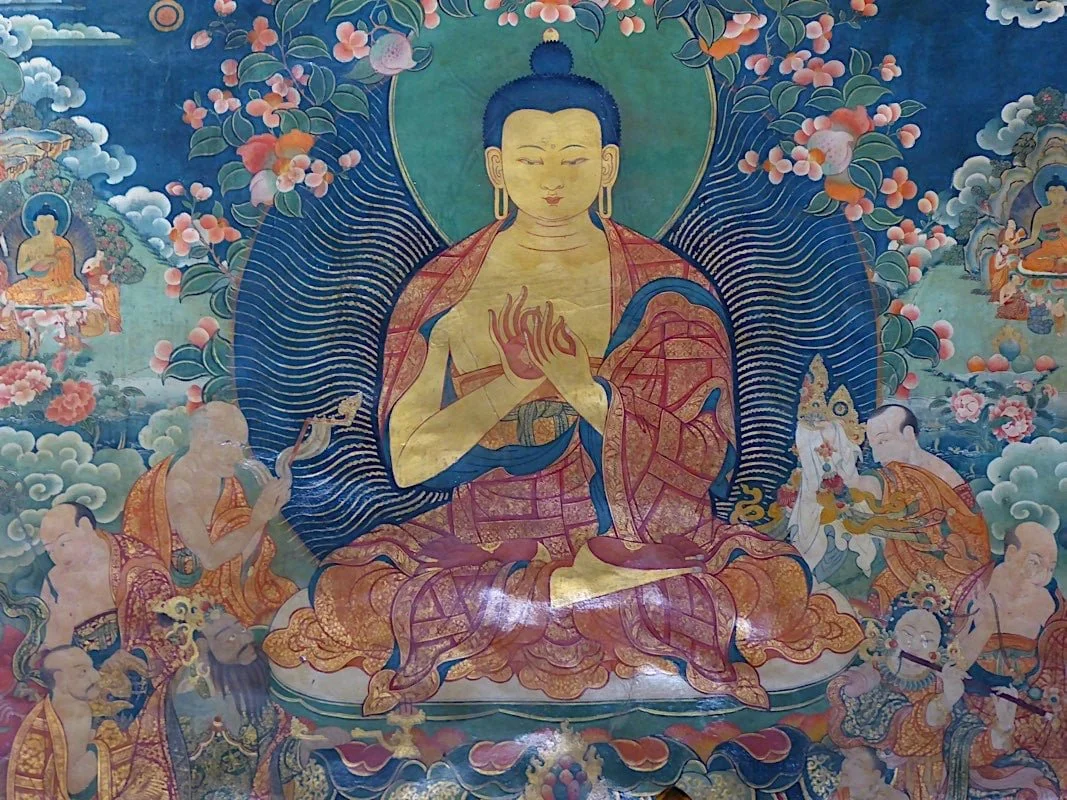
Photo from the Jokhang Temple, Lhasa, Tibet, Wikicommons
Abhaya (No Fear) Mudra
In this mudra, the Buddha has his right hand raised in front of him, the palm facing outward, the fingers pointing upward. This gesture portrays fearlessness and protection. It is also a sign of reassurance, like “you can do it,” symbolizing perseverance.
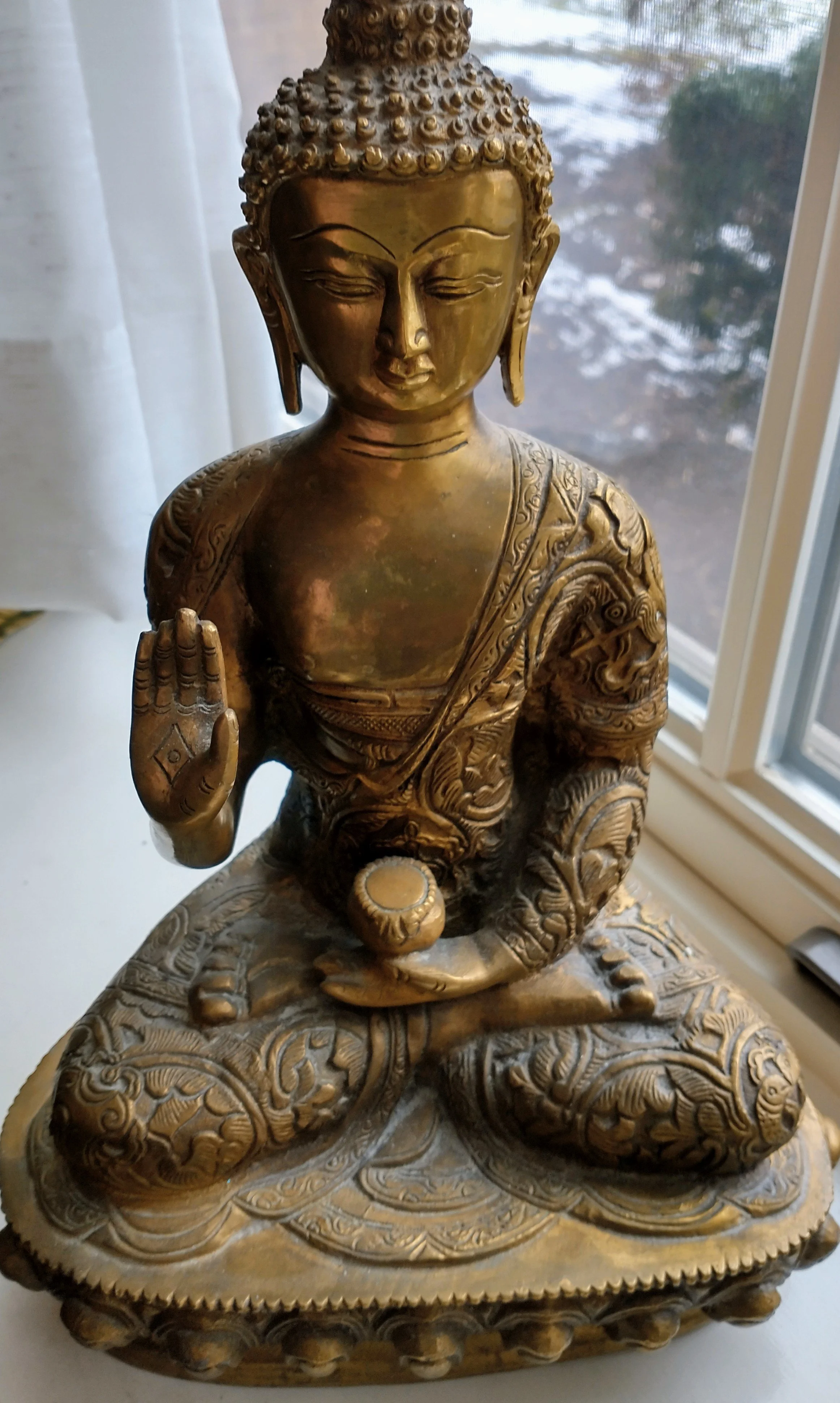
This is the Buddha who sits on my bedroom windowsill, with the open hand signifying fearlessness, safety, and protection. This figure came back with me from India and provides daily reminders of why we take refuge in the Buddha.
According to tradition, the Buddha performed this gesture, the abhaya mudra, after enlightenment, to calm a raging elephant that had been loosed on him by a rival. The abhaya mudra is often said to symbolize the Buddha’s ability to engender peace, compassion, and protection for all beings.
— Joy Mitra [Photo by Joy]
Varada or Dana (Gift-Bestowing) Mudra
In this mudra, the Buddha’s hand is reaching for the Earth with the palm facing outward in what is known as the bliss-bestowing gesture. This is a mudra of charity and generosity—the Buddha is offering his qualities to the world—especially the gift of knowledge. This gesture is also associated with Avalokitesvara (Guanyin) and other bodhisattvas, and reminds us that generosity helps liberate us from greed and anger.
The mudra is often depicted using the left hand, but sometimes it is shown with the right hand, and in the left is a symbolic or ritual object. The Medicine Buddha, who holds a bowl with healing herbs, is one example.
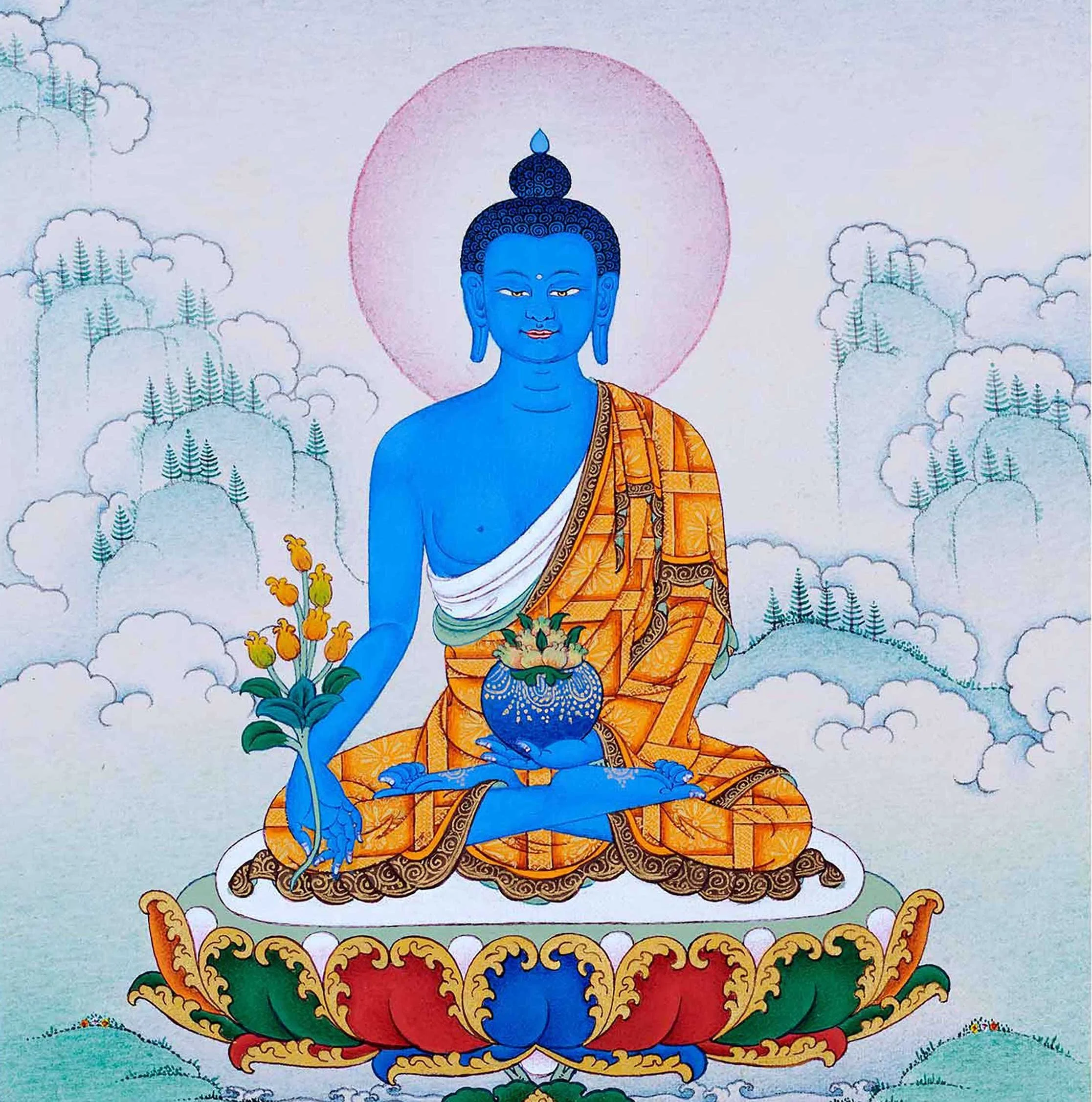
Photo courtesy of Vajrayana Institute
Make it stand out
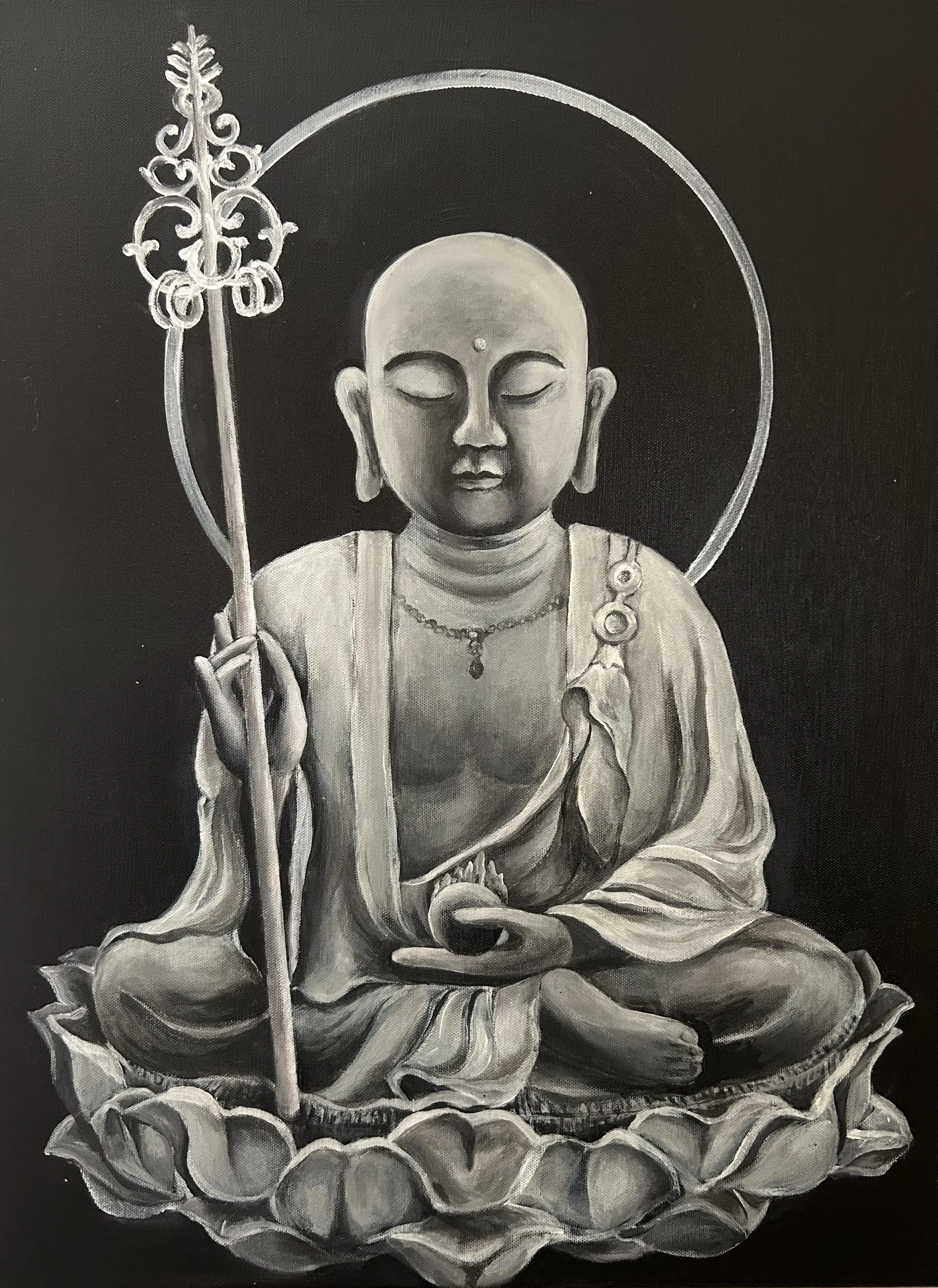
Here is a painting that my wife, Shuyuan Lee Buccino, made last year of Ksitigarbha, the bodhisattva whose great vow is to rescue all beings from hell. She has spent quite some time chanting and studying the Ksitigarbha Sutra. In this image, Ksitigarbha holds a wish-fulfilling jewel that represents the power of enlightenment, and a staff that has two functions: Its rings make noise so small animals will get out of the way and not be stepped on(!); the staff is also imagined forcing open the gates of hell. His right hand is in the harina mudra, often used to hold symbolic objects.
—Neal Buccino [Photo by Neal]
Dhyana (Samadhi) Mudra
In this mudra, the Buddha hold his hands in his lap, in the position we associate with meditation. The right hand rests atop the left, with the palms facing up and his thumbs touching. This position symbolizes the Buddha’s concentrated mind, dwelling in samadhi. It reminds of us of the importance of meditation practice, and the deep happiness that is available for the concentrated mind.
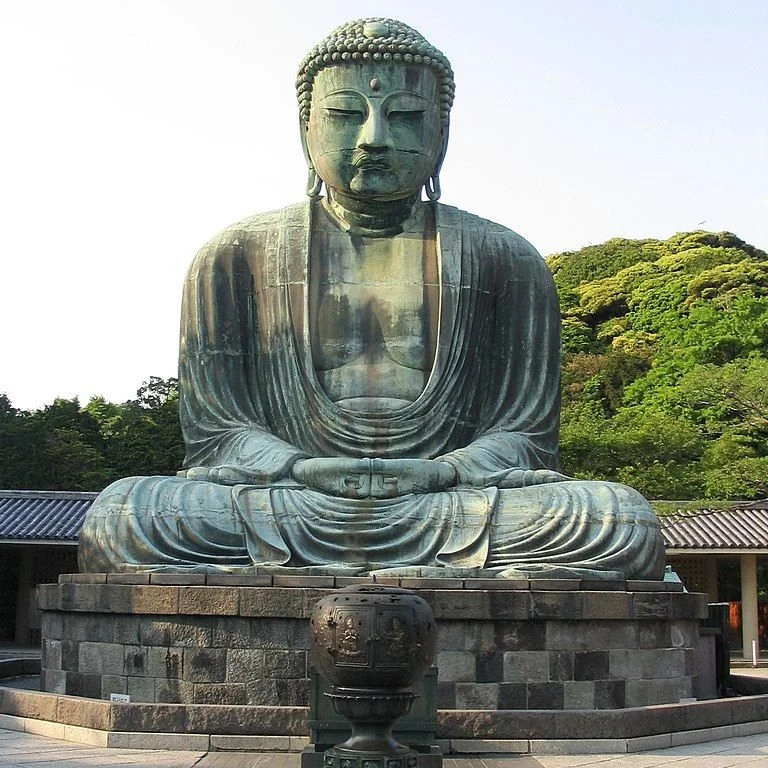
Photo by Dirk Beyer, Wikicommons
This photo (below) was taken during my first visit to the Dharma Drum Mountain World Center for Buddhist Education in Jinshan, Taiwan, in December. At the time, the mudras on the book covers spoke to me as a reminder of steadiness and trust—of meeting practice just as it is. It continues to remind me to return to what is solid and present, including in moments of uncertainty.
— Jenny Tseng
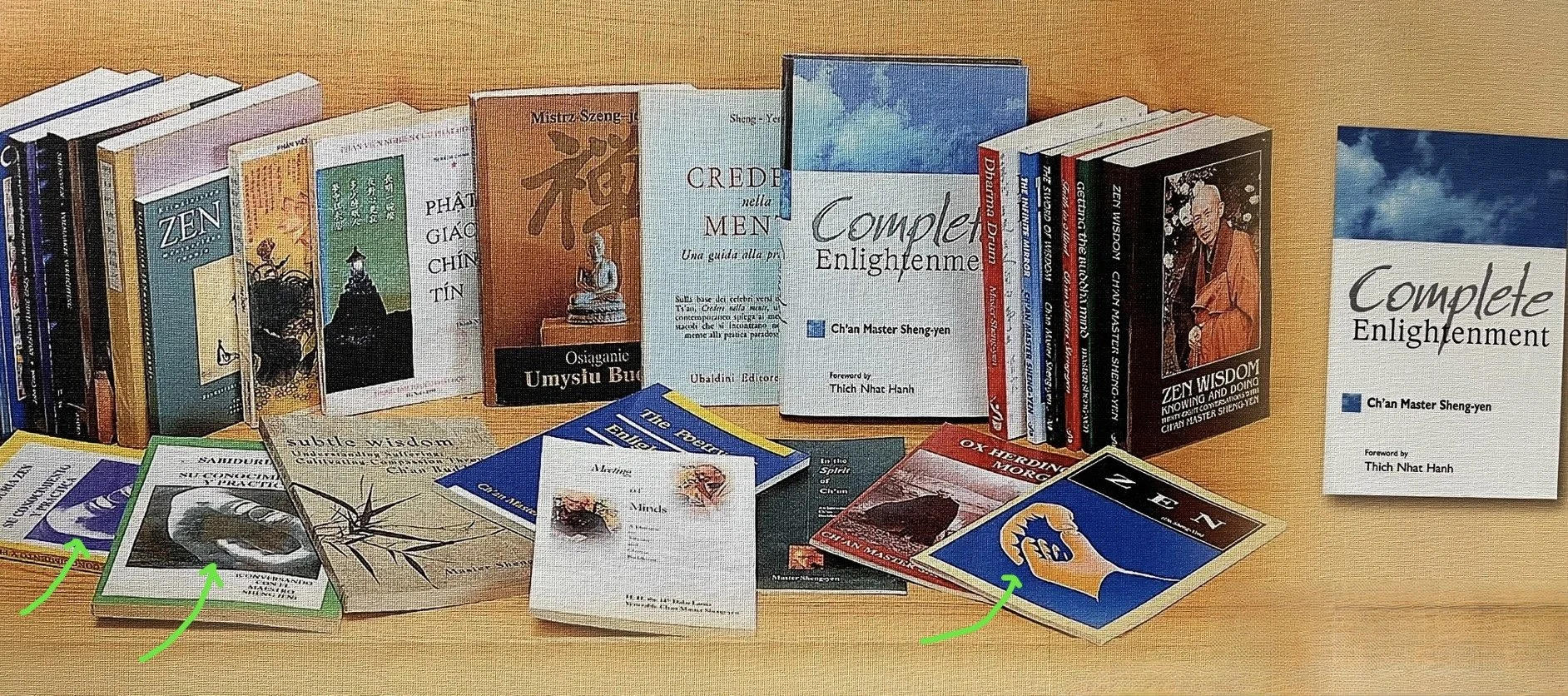
Photo from Dharma Drum Mountain World Center for Buddhist Education
Vitarka (Teaching) Mudra
In this mudra, the Buddha raises his hand, palm facing outward, with his thumb and index finger touching to form a circle. It symbolizes the transmission of knowledge and insight, and is often depicted in statues and images of the Buddha as a teacher or a guide. “Vitarka” can mean reasoning or deliberation, and reflects the importance of dialogue, debate, and sharing ideas in Buddhist practice. The Dharma Drum Mountain logo is the vitarka mudra along with three mountain peaks and the profile of a monk meditating.
This triptych image is a reflection of a vivid moment when I observed Thich Nhat Hanh doing mudras while chanting. The gentleness and compassion I sensed in his movements touched me, and I understood how mudras can help us to focus, bringing the body, together with the mind, in concentration. In answering a child’s question about his hand movements, Thich Nhat Hanh made the vitarka mudra, facing in, close to his body, and shared how when he does this he’s touching the suffering within himself. Still making the mudra, he turned his hand to face out and said that his awareness expands to the suffering of others. He then reached forward with the mudra, opening his hand and shared that this is touching the suffering far away in the world.
—Taylor Mitchell
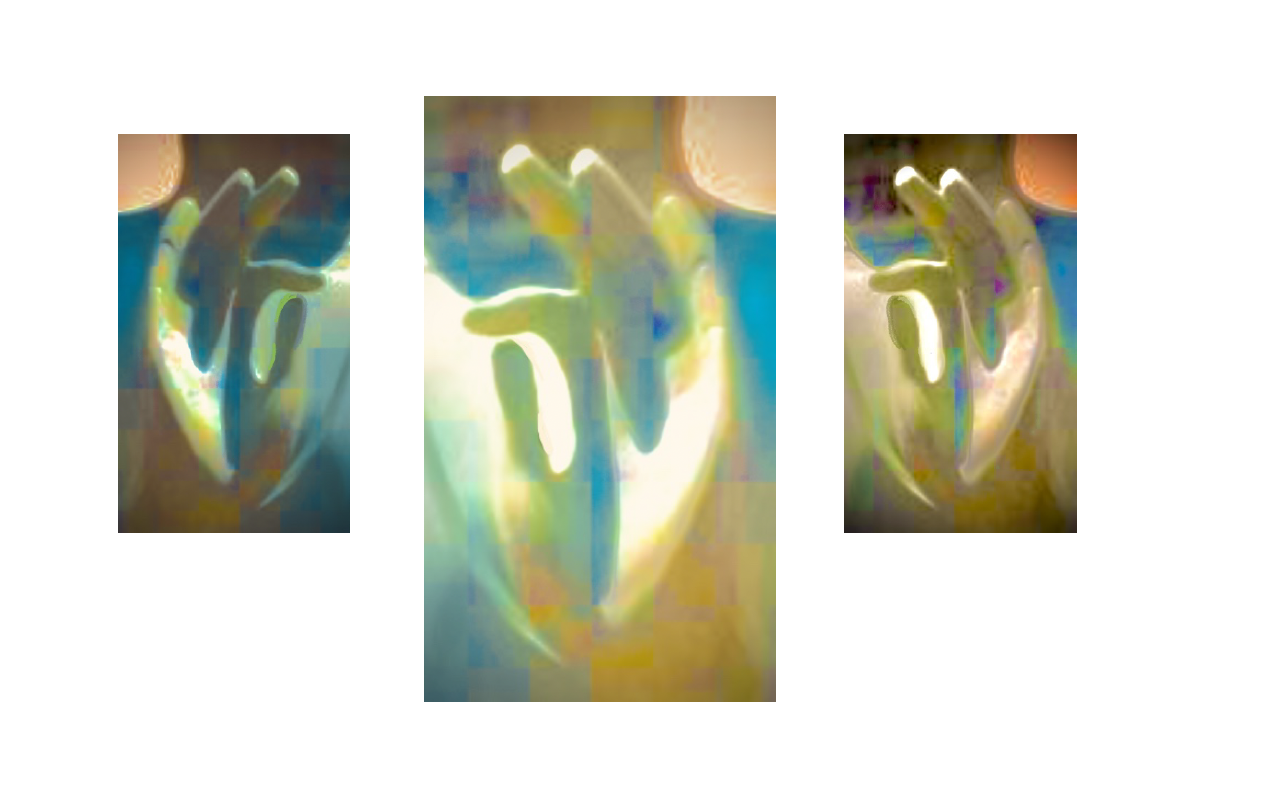
Tryptich created by Taylor
Chan Dharma Community
Practice Opportunities
Monthly Online Dharma Study Course with Rebecca Li
2nd Wednesday of the month from December 10, 2025 - May 13, 2026
Practitioners meet on Zoom on the second Wednesday of the month to share their reflections on the month’s theme, based on a Dharma talk given by Rebecca Li. The topic of this year’s course is “Realizing the Four Noble Truths.”
Weekly Sitting Meditation
Monday Mornings, 7:00 to 7:25 AM ET
Wednesday Mornings, 7:00 to 7:25 AM ET
Thursday Evenings, 9:00 to 9:25 PM ET
All sessions include light neck stretches, recitation of the Four Great Vows, and a 20-minute sitting period.
*The weekly meditation sessions are intended for Chan Dharma Community members who have practiced with Rebecca Li. All levels of experience are welcome.
Online Sangha Friends Gathering
4th Wednesday of every month
Join us for an unstructured gathering where we can check in with one another, talk about whatever has come up in the past month, support one another, and stay in touch as a sangha. Each gathering will begin with 10 minutes of meditation, and then everyone will check in and share, and discuss what comes up.
One-Day Online Retreat
January 31 (and other dates to be set throughout the year)
This is an at-home online retreat led by Rebecca Li. It is typically a full-day silent retreat from 9:45 am to 6 pm ET (6:45 am to 3 pm PT). The retreat is conducted over Zoom, and participants join by video during sitting meditation periods and Dharma talks.
Sangha Sharing
April 29 (and other dates to be set throughout the year)
Sangha Sharing is a way for practitioners to share and learn about personal projects, hobbies, passions, family, pets, or anything else that is very meaningful. It’s a chance to connect with others in the sangha on a deeper level, while practicing gratitude and generosity by reflecting on what is important to us, and listening to what is important to others.
Please contact us if you would like more information about the programs or to be added to the contact list for the Sangha Friends Gathering.
Stay in Touch
Chan Dharma Community Links
Dr. Rebecca Li
Talks, Retreats, and Other Opportunities
2026 Workshops & Talks:
February 8 (Sun) 9 am to noon ET (In person)
Meditation Workshop and Dharma Talk, DDMBA-NJ Chapter, Edison, NJ
February 21 (Sat) 11 am to 12:30 pm ET (Online)
Public Dharma Talk: Realizing the Four Noble Truths as a Chan Practitioner–Part 5, Global Meditation Center, New York, Queens, NY
April 12, 2026 (Sun) 9 am to noon ET (In person)
Meditation Workshop and Dharma Talk, DDMBA-NJ Chapter, Edison, NJ
May 2 (Sat) 11 am to 12:30 pm ET (Online)
Public Dharma Talk: Realizing the Four Noble Truths as a Chan Practitioner–Part 6, Global Meditation Center New York, Queens, NY
September 13 (Sun) 9 am to noon ET (In person)
Meditation Workshop and Dharma Talk, DDMBA-NJ Chapter, Edison, NJ
November 8, 2026 (Sun) 9 am to noon ET (In person)
Meditation Workshop and Dharma Talk, DDMBA-NJ Chapter, Edison, NJ
2026 Retreats
April 24-26, 2026 (Fri-Sun, In person) Foundation Retreat, Dharma Drum Retreat Center (DDRC), Pine Bush, NY
May 23-30, 2026 (Sat-Sat, In person)
Intensive Silent Illumination Retreat, Dharma Drum Retreat Center (DDRC), Pine Bush, NY
July 4-11, 2026 (Sat-Sun, In person)
Seven-Day Silent Illumination Retreat, Western Chan Fellowship, Shawbottom Farm, Peak District Retreat, England, United Kingdom
August 21-23, 2026 (Fri-Sun, In person)
Beginner’s Mind Retreat, Dharma Drum Retreat Center (DDRC), Pine Bush, NY
October 2-7, 2026 (Fri- Wed, In person)
Western Zen Retreat, Dharma Drum Retreat Center (DDRC), Pine Bush, NY
December 4-7, 2026 (Fri- Wed, In person)
Four-day Chan Retreat, Dharma Drum Mountain San Francisco Bay Area Center, Fremont, CA
For more info about Rebecca’s teachings, please click on the button below
Books by Rebecca Li

Illumination: A Guide to
the Buddhist Method of
No-Method
Published by Shambhala Publications on October 31, 2023.
Available now at: Shambhala, Penguin Random House, Amazon, Barnes & Noble, and other booksellers

Allow Joy into Our Hearts: Chan Practice in Uncertain Times
Published by Winterhead
Publishing, 2021
Available now on: Indiebound, Kobo, Barnes & Noble and Amazon
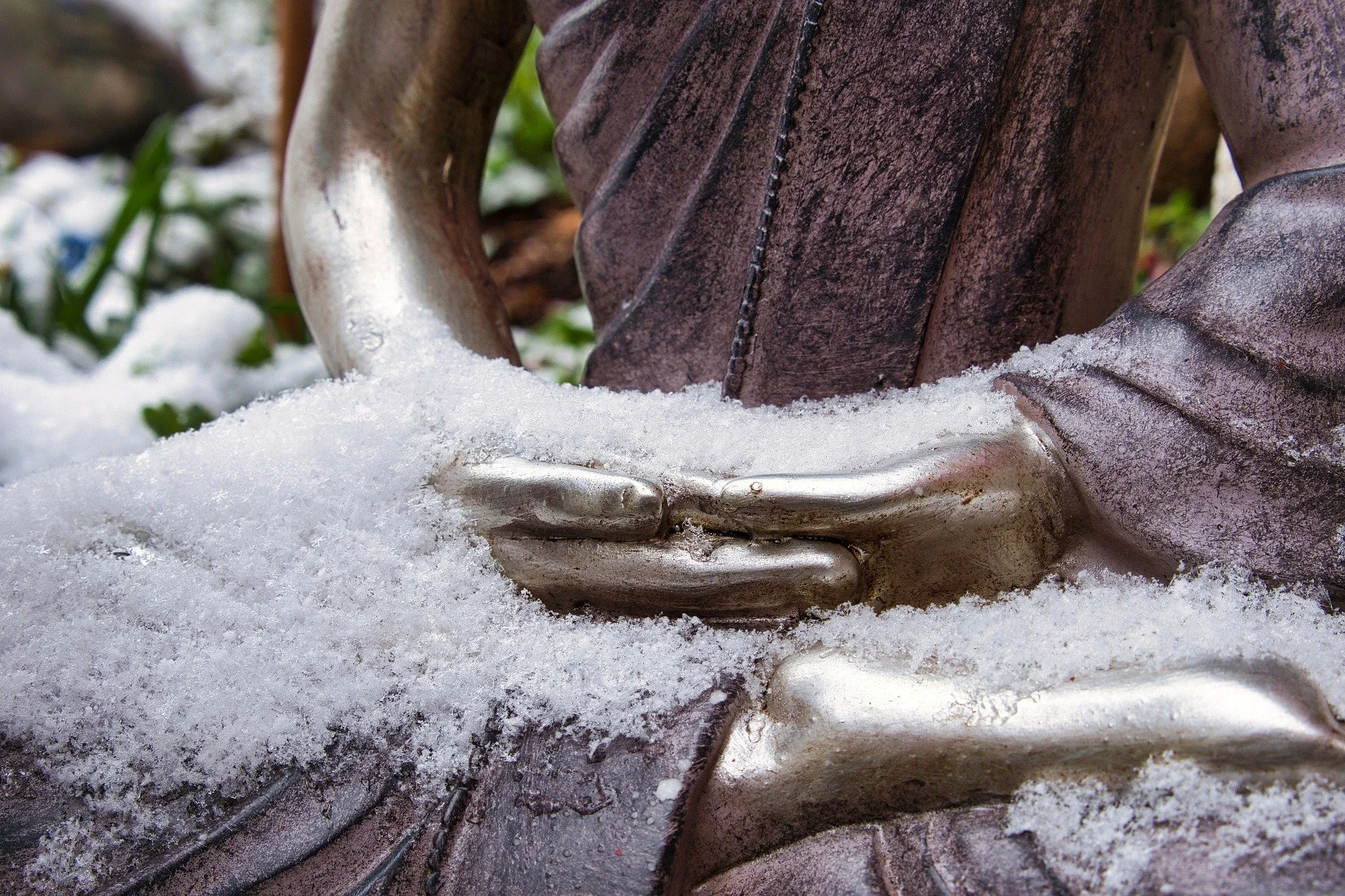
“The world is blessing us with many opportunities to practice. We have much to be grateful for indeed.”
— Rebecca Li
Copyright (C) 2025 Chan Dharma Community. All rights reserved.
You are receiving this email because you opted in via our website.
Our mailing address is:
Chan Dharma Community PO Box 6202 Bridgewater, NJ 08807-0202 USA